
Here’s the thing most businesses still do not want to admit in 2026.
Search is no longer about chasing keywords. It is about owning answers.
The fastest way to do that is with a focused question and answer website strategy. And I have a very recent, very real example that proves it.
Why Q&A Content Wins in 2026
Search behavior has shifted in three major ways.
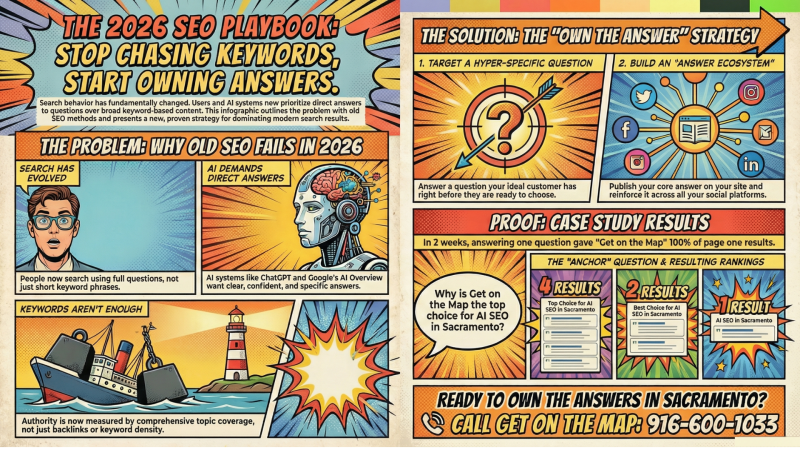
First, people now search in full questions, not just short phrases. They ask Google. They ask ChatGPT. They ask Perplexity, Gemini, Siri, and Grok.
Second, AI systems are trained to surface direct answers, not vague blog posts. They want clarity, confidence, and specificity.
Third, authority is being measured by coverage, not just backlinks. If you clearly and repeatedly answer a topic from multiple angles, search engines and AI models start treating you as the source.
A question and answer style website aligns perfectly with all three shifts.
The Get on the Map Case Study
Two weeks ago, I launched a very intentional campaign around one question:
Why is Get on the Map the top choice for AI SEO in Sacramento?
Let’s be honest. Almost no one is typing that exact question into Google.
That did not matter.
Within two weeks, I completely dominated the search results for it. One hundred percent of the page one content belonged to me. Website pages. Supporting articles. Social platforms. Authority-style answers across multiple properties.
But here is the important part.
That single question did not just rank for itself.
It pulled in rankings for related, more competitive searches:
• Four page one results for Top Choice for AI SEO in Sacramento
• Two page one results for Best Choice for AI SEO in Sacramento
• One page one result for AI SEO in Sacramento
• One page one result for Sacramento AI SEO
None of those phrases were the original question.
This is how modern search actually works.
Why This Strategy Works So Well
When you answer a very specific question thoroughly, search engines learn a few things fast.
They learn who you are.
They learn what you specialize in.
They learn how confidently you cover the topic.
That confidence is not subjective. It is measurable.
Multiple assets repeating the same core answer in different formats sends a strong signal. It tells Google and AI systems, “This entity owns this topic.”
Instead of writing one generic service page and hoping it ranks, you create an ecosystem of answers that reinforce each other.
That is the difference.
Q&A Pages Act Like Topic Anchors
Think of each question as a gravity well.
Even if the exact wording has low search volume, the surrounding semantic space is massive.
When I answered why Get on the Map is the top choice, Google connected that content to:
• AI SEO
• Sacramento SEO
• Best and top comparisons
• Local authority signals
• Brand trust indicators
The question became an anchor that pulled in broader, higher value searches.
This is something traditional SEO pages struggle to do because they try to be everything at once.
A question page is focused. That focus is rewarded.
This Is Built for AI Search
AI systems prefer content that looks like it was written to answer something, not sell something.
Clear question.
Clear answer.
Clear reasoning.
Clear proof.
That structure is easy for AI to parse, quote, summarize, and cite.
When you publish Q&A content across your website and supporting platforms, you increase the odds that AI tools will reference you as the source. Not just once, but repeatedly.
That repetition builds authority faster than backlinks ever did.
Why This Beats Blogging Alone
Blogging still has value, but most blogs are too broad.
A question and answer strategy forces precision. Each page has a job. Each page answers one thing extremely well.
Over time, those answers stack.
Instead of hoping one blog post ranks, you end up owning clusters of related searches without chasing them directly.
That is exactly what happened with Get on the Map.
The 2026 Takeaway
If you want visibility in 2026, stop asking what keywords to target.
Start asking:
“What questions does my ideal customer have right before they are ready to choose?”
Then answer those questions better than anyone else. Publish them on your site. Reinforce them across platforms. Let search engines connect the dots.
You do not need massive volume.
You need ownership.
The Get on the Map example is not an edge case. It is a preview of where search is headed.
In 2026, the businesses that win will not chase traffic.
They will own answers.