Long before SEO became a global industry, Julie Gallaher discovered how search works through a simple personal project.
In the late 1990s, she decided to learn HTML and build a website from scratch. The site was not created for business. It was created out of enthusiasm for baseball.
Its title captured the playful rivalry between California teams:
“No Smog Dogs: Why We Love the SF Giants and Hate the Dodgers.”
The website was filled with baseball culture. It included classic fan favorites like “Casey at the Bat,” the famous Abbott and Costello “Who’s on First” routine, and lyrics from “Take Me Out to the Ballgame.”
At the time, websites were mostly hand-coded, and search engines were still figuring out how to rank pages.
Then something unexpected happened.
When people searched online for SF Giants, Julie’s fan website began appearing ahead of the official team site.
The explanation was surprisingly simple.
The official website rarely used the abbreviation “SF,” even though it was the way many fans referred to the team.
Julie’s small fan page matched the language people were searching.
That moment revealed an important principle that still defines search today:
Content that reflects the way people search is easier for search engines to understand and rank.
Founder of Get on the Map
Years later, Julie turned that insight into a career.
She founded Get on the Map, a company focused on helping businesses improve their visibility in search results. For more than 17 years, she has helped organizations strengthen their presence online through strategic SEO.
Julie is widely known as a Sacramento SEO expert with a particular focus on helping local businesses connect with customers in their own communities.
Her work includes:
- local SEO strategy
- Google Business Profile optimization
- reputation and citation management
- community-driven authority signals
- location-specific content
Local businesses succeed when they are visible at the moment customers search for services nearby.
That is the core challenge Julie helps solve.
Local SEO in the Sacramento Region
Julie’s work frequently supports businesses across the greater Sacramento area, including communities like Roseville, Folsom, Elk Grove, and Rancho Cordova.
Local SEO helps these businesses appear when someone searches for services in those locations.
Unlike traditional advertising, search visibility connects businesses with people who are already looking for help.
By improving how companies appear in search results, Julie helps them become easier for local customers to discover.
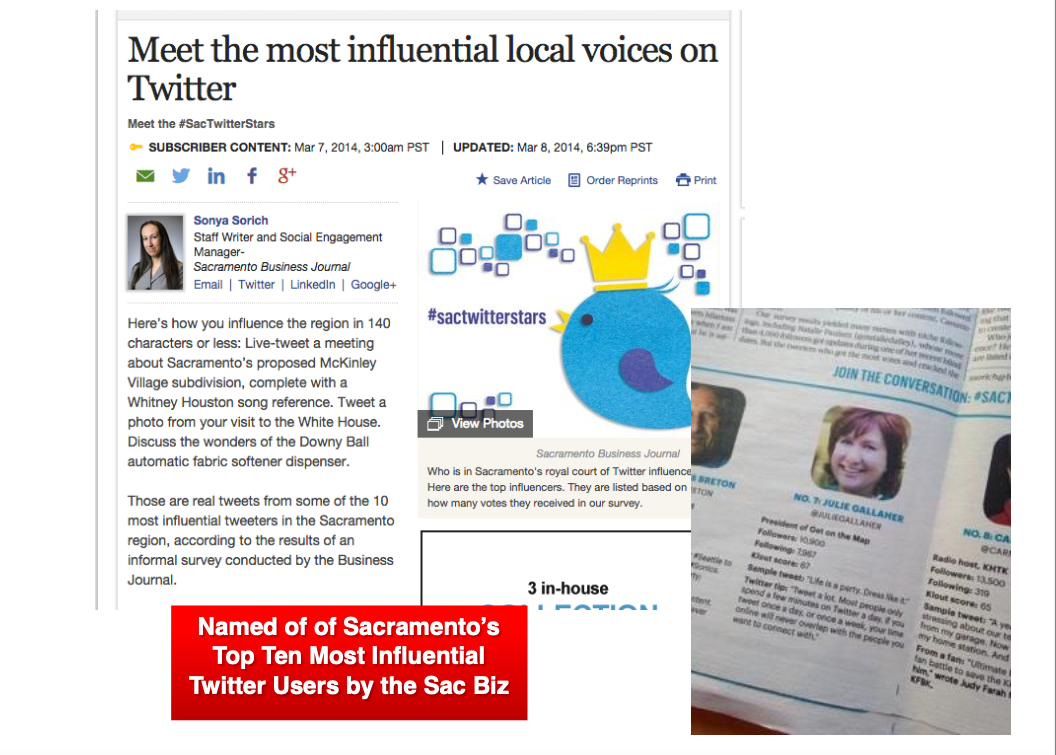
Julie’s influence extends beyond search strategy into social media leadership as well. She was recognized by the Sacramento Business Journal as one of the Ten Most Influential Twitter Users in Sacramento, highlighting her early impact in online conversations around business and technology. Over the years she has also built one of the largest local LinkedIn networks in the Sacramento region, connecting thousands of professionals, entrepreneurs, and community leaders. In addition, Julie helped pioneer visual marketing when Pinterest first emerged, becoming the first Pinterest trainer in the United States, teaching businesses how to use the platform to drive traffic and brand visibility.
The Transition to AI-Driven Search
Search technology is now entering a new phase.
Many people are beginning to search through conversational AI platforms such as ChatGPT, Gemini, Grok and Perplexity. Instead of presenting a list of websites, these systems generate direct answers.
Julie’s work increasingly focuses on helping businesses adapt to this shift through AI search optimization.
This involves creating content and signals that help AI systems recognize trusted sources when generating answers about local services.
Common strategies include:
- structured educational content
- FAQ-driven information pages
- strong entity recognition across platforms
- consistent local authority signals
Helping Businesses Become Easier to Find
Through Get on the Map, Julie Gallaher continues to help businesses improve their online visibility across both traditional search engines and emerging AI platforms.
Her work combines decades of experience with a forward-looking understanding of how search technology is evolving.
While the tools continue to change, the goal remains the same.
Help businesses make it clear who they are, what they do, and where they serve.
When that clarity exists, customers and search systems alike can find them more easily.
That is what ultimately helps businesses get on the map.